

The CHRO’s job isn’t what it used to be.
Once predominantly associated with hiring, benefits and employee relations, today’s top HR executive is increasingly expected to help shape business strategy, improve workforce productivity, manage organizational transformation and prepare employees for an AI-driven future.
For CEOs, the stakes are substantial. Decisions about workforce capabilities, leadership succession and the adoption of new technologies can determine whether a company executes its growth strategy—or falls behind competitors.
But as the demands on HR leadership evolve, compensation appears to be moving in a different direction.
Our latest analysis of executive compensation shows that median CHRO pay increased less than 1 percent in 2025, continuing a multiyear slowdown. And while base salaries have risen since before the pandemic, median bonuses have fallen.
The findings raise an important question for companies relying on HR leaders to manage increasingly consequential business challenges: Are they still compensating CHROs for the job they used to do?
Pay Growth Has Almost Stopped
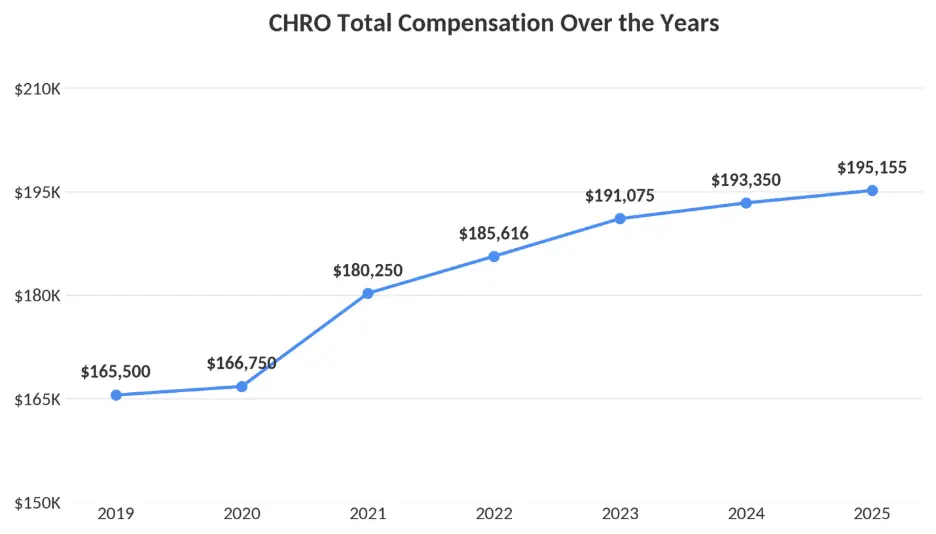
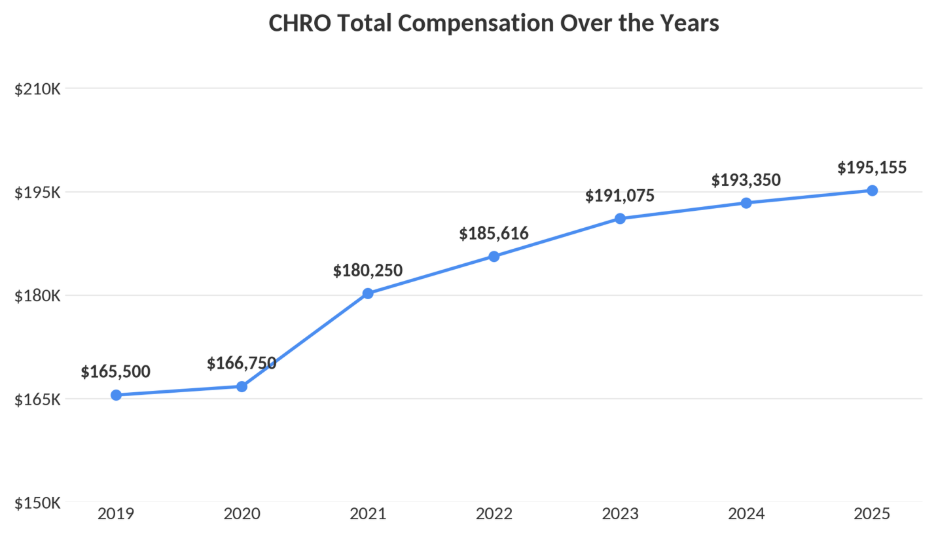
In 2025, the median CHRO at a U.S. private company earned $195,155 in total compensation, including a base salary of $156,283, a $13,672 bonus and $25,200 in benefits and perks. That was an increase of just 0.9 percent from 2024, following a 1.2 percent increase the year before.
The longer-term picture is more revealing: In 2019, median total compensation for the senior HR executive was $165,500. By 2025, it had increased approximately 18 percent.
But the gains have been slowing. Compensation rose more substantially in the years immediately following the pandemic, then settled into increasingly modest increases.
Meanwhile, median base salary rose approximately 25 percent between 2019 and 2025, from $125,000 to $156,283.
The result is a compensation package increasingly supported by fixed salary rather than larger annual performance rewards.
The Bonus Disconnect
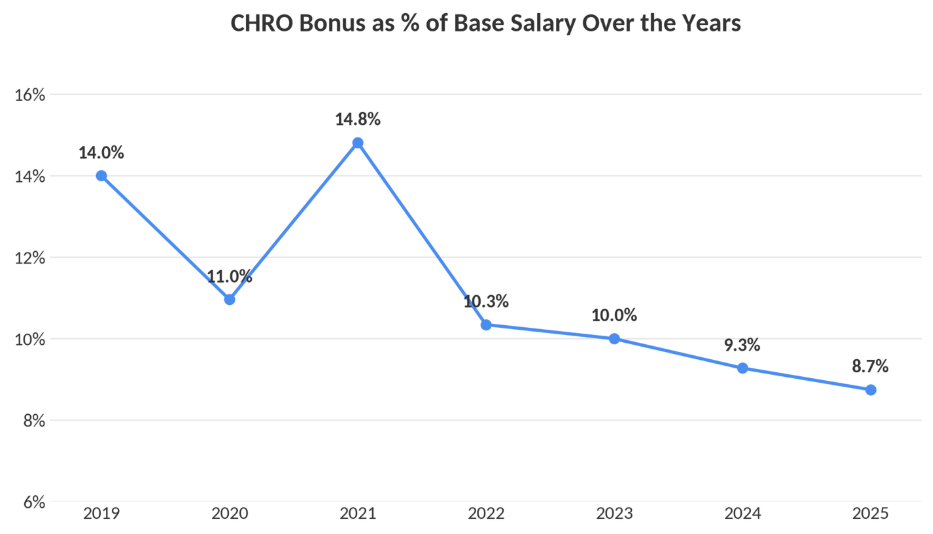
Perhaps the most striking finding is what happened to bonuses: The median CHRO received a $17,500 bonus in 2019. Six years later, that figure had fallen to $13,672—a 22 percent decline.
In 2025 alone, the median bonus slipped by $578.
Compare that with the company’s other senior leadership positions. CFOs and operating executives typically have performance measures that can be closely associated with financial outcomes, from profitability and working capital to operating efficiency.
CHRO performance can be harder to capture in a single financial metric. So, how should a company measure the value of developing stronger leaders? Improving workforce capabilities? Reducing regrettable turnover? Helping employees and managers adopt AI successfully?
These initiatives can contribute meaningfully to organizational performance, but their benefits may emerge over years rather than quarters.
That creates a compensation-design challenge. If companies increasingly expect CHROs to produce measurable business outcomes, incentive programs may need to evolve to reflect those expectations. Otherwise, the financial rewards may remain tied to a narrower, more traditional understanding of the role.
Size Still Determines the Stakes
As with other senior executive positions, company size remains a major driver of CHRO compensation.
In 2025, the median CHRO at companies generating $50 million to $99.9 million in revenue earned $194,800. At companies generating $100 million to $249.9 million, median compensation reached $246,971.At companies with $250 million to $499.9 million in revenue, it climbed to $325,840—67 percent above the median at companies with $50 million to $99.9 million.
For businesses approaching a new stage of growth, that difference matters. A CHRO capable of helping a company manage a larger, more complex workforce may be competing for positions at organizations offering substantially more generous compensation.
And the gap isn’t only in salary. At larger companies, variable compensation increasingly contributes to the overall package.
Of course, compensation alone likely won’t keep your CHRO from considering other opportunities. But the numbers should encourage CEOs and boards to examine how they assess the position. Is the CHRO primarily being compensated for administering HR functions or for contributing to measurable strategic outcomes? Are incentives tied to priorities such as productivity, leadership development and organizational readiness? Does the compensation package reflect the growing complexity of the role?
Companies don’t necessarily need to pay more to answer those questions effectively. They may need to think differently about what they’re rewarding.
Explore more executive compensation benchmarks by company size, industry and ownership structure in our latest report at chiefexecutive.net/compreport