

Anyone who has read enough Yelp reviews knows a basic psychological truth. The loudest voices tend to come from the extremes.
Research confirms that people with the most extreme opinions are the most likely to speak up. This dynamic plays out when companies debate in-office policies. These conversations are dominated by two groups of employees: those who hate the office and those who love it. But if leaders rely only on these loud voices, they risk designing policies that swing too far toward one pole, often ending up with too little in-person time to tap into the Proximity Effect, the synchronicity that comes from working side by side, making it easier to communicate, learn and build on one another’s ideas.
A different but equally problematic dynamic arises when executives dominate the conversation. Leaders are not typical employees. The drive that propelled them to the top and the responsibilities that come with leadership mean they have an unusual relationship with work—including remote work.
Executives like remote work far less than most employees do. And, like most people, they tend to assume that others see the world as they do. A large-scale survey of employees and their managers found that leaders underestimated how much their employees value remote work by 44 percent. This inability to intuit others’ preferences—what scholars call “projection bias” and what the rest of us call “not being mind readers”—has material consequences. When leaders craft office policies based on their own intuitions, they often choose arrangements with too little remote work, leading to poorer morale, weaker recruiting and higher turnover than necessary.
Getting office policy right requires more than following the loudest voices or relying on leaders’ instincts. Anecdotes can always mislead, especially since every policy will help some employees and frustrate others. The goal is not to please everyone, but instead to design a policy that fits the company, the workers and the work. Evidence helps point the way.
Fortunately, we now have data on what works and what doesn’t work for a wide variety of companies. The recent evidence goes beyond short-run outcomes, offering a more nuanced view of long-term trade-offs. The findings show that one size does not fit all. The right office policy depends on a firm’s tasks and talent. What’s right for a direct-to-consumer startup may be entirely wrong for a marketing agency or a derivatives desk.
We have distilled the evidence into a practical framework for choosing the right amount of in-office time for your organization. It’s designed to help leaders tailor the office policy to their actual work and workforce. For some companies, this framework will suggest that a five-day in-office policy would be best. For others, regular offsites will create more value than weekly in-office time. For many, the best policy lies between these extremes: a hybrid policy that captures the power of being in person without alienating talented employees who value remote work.
Deciding How Much Proximity Is Right for Your Organization
Scarcity raises value, and abundance dilutes it. This Scarcity Framework is a core tenet of decision-making science and turns out to be central to office policy. Leaders need to think about scarcity of two resources: time in the office and time at home.
Consider a team that never sees one another in person. For them, face-to-face time is scarce and therefore precious. An experiment in a Turkish call center showed that bringing fully remote teams together just once a month led to substantial productivity gains, which persisted when they were apart. That single day per month to check in, compare notes on what was working and troubleshoot what wasn’t paid dividends that lasted for weeks. The first moments together unlock disproportionate benefits from shoulder taps, rapid iteration and teaching moments that rarely happen at a distance.
Employees feel this too. When in-person time is scarce, it becomes valuable for bonding and morale. In the Turkish call-center experiment, teams that periodically came together had lower attrition than those who remained fully remote. Large-scale surveys echo this pattern. Most workers prefer hybrid schedules to fully remote ones. The typical worker would sacrifice 6–8 percent of their earnings for a hybrid schedule, but would not pay at all for a fully remote one. The fact that employees demand the same salary for jobs that are always at home as for jobs that are always in the office suggests that both setups feel onerous. Thus, the first dose of in-person work often benefits employees as much as employers.
Now consider the opposite extreme: teams that are together all the time. On these teams, what’s scarce, and consequently valuable, is time away from the office. Such time would allow employees to catch up on laundry between calls, extend a family trip or take a dog to the vet without braving multiple commutes. A bit of distance can also make colleagues’ hearts grow fonder of one another. Consistent with these advantages, just one day at home can slash attrition. In the best experiment on this topic, attrition went down by a third for employees who spent one day at home compared with employees who remained in the office five days a week.
From a productivity perspective, the fifth day in the office has also lost some of its shimmer. For many fully onsite teams, the scarcest resource is no longer time to collaborate but instead time to focus without interruption. Therefore, adding some remote time can even boost productivity. In some organizations, particularly those where senior employees spend much of their time on solitary work, a dose of remote work increases output. In other companies, it is productivity-neutral, but the gains in recruitment and retention make it a net win. However, in companies where work revolves around strong relationships, rapid iteration or other in-office strengths, even a small dose of remote work can be a drag on performance. Across companies, the first day in the office is almost always more valuable than the fifth; what differs is how quickly the value tapers off.
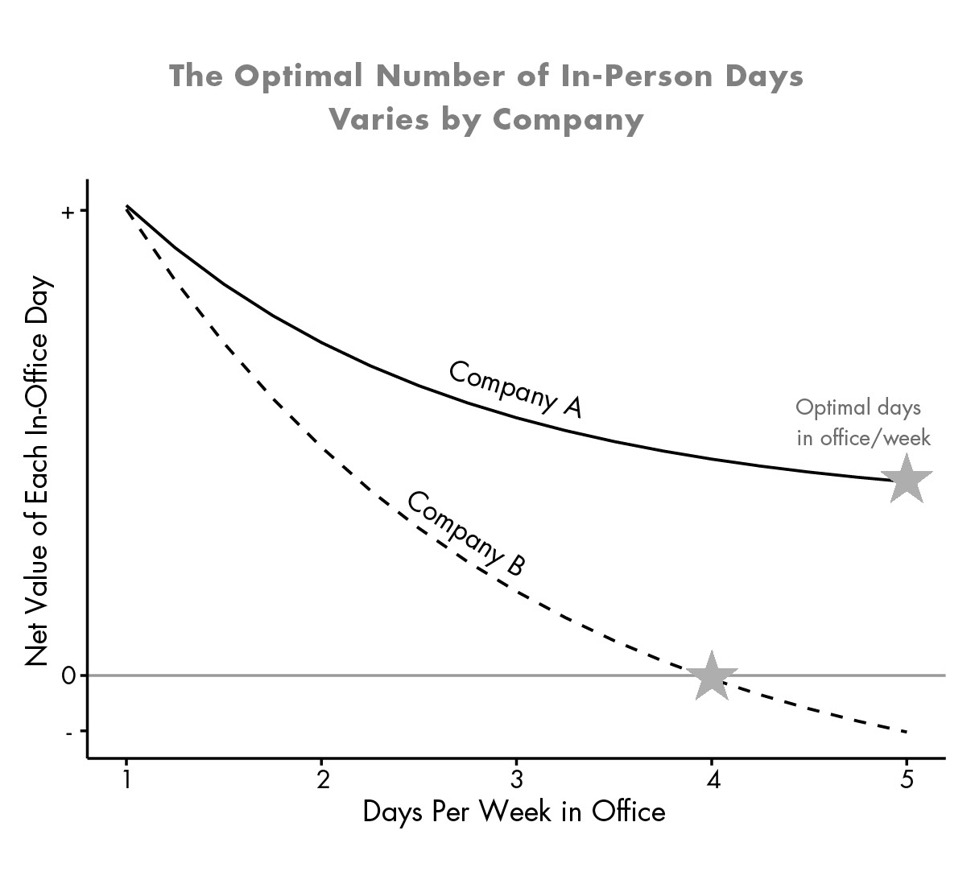
This variation means there is no single “right” in-office policy. For some organizations (Company A in the figure), each additional day in the office still adds value, even if at a diminishing rate. Thus, a fully in-office schedule is sensible. For others (Company B in the figure), the final day dips from benefit to burden, crowding out focus time and making it harder to recruit and retain talent. Those firms are better served by a hybrid model.
The challenge for leaders is not choosing sides in a remote-versus-office debate, but instead identifying the trade-offs that apply to their organization and then designing a policy that fits the organization’s work, people and needs. We outline the five crucial questions that leaders must consider when determining the right office policy for their organization. This calculus assumes that everyone on a team—and ideally in a business unit—comes into the same office on the same days. The benefits of in-person work are nearly impossible to capture if teammates work out of different offices. Similarly, these benefits are elusive if teammates come into the same place but not at the same time.
We offer the calculator below to synthesize the trade-offs between in-office work and remote work. Use it as a starting point for a conversation—not as a final answer. The underlying evidence makes clear that each criterion matters and the direction in which it should nudge the optimal number of in-office days. The precise weights, however, reflect our informed judgment about their relative importance. For simplicity, the calculator is framed in terms of days per week in the office. This is a convenient shorthand for how much work is done face-to-face, not a prescription for how to structure the time. Some organizations may choose to cluster in-person work by the month or around key moments rather than spread it evenly across every week.
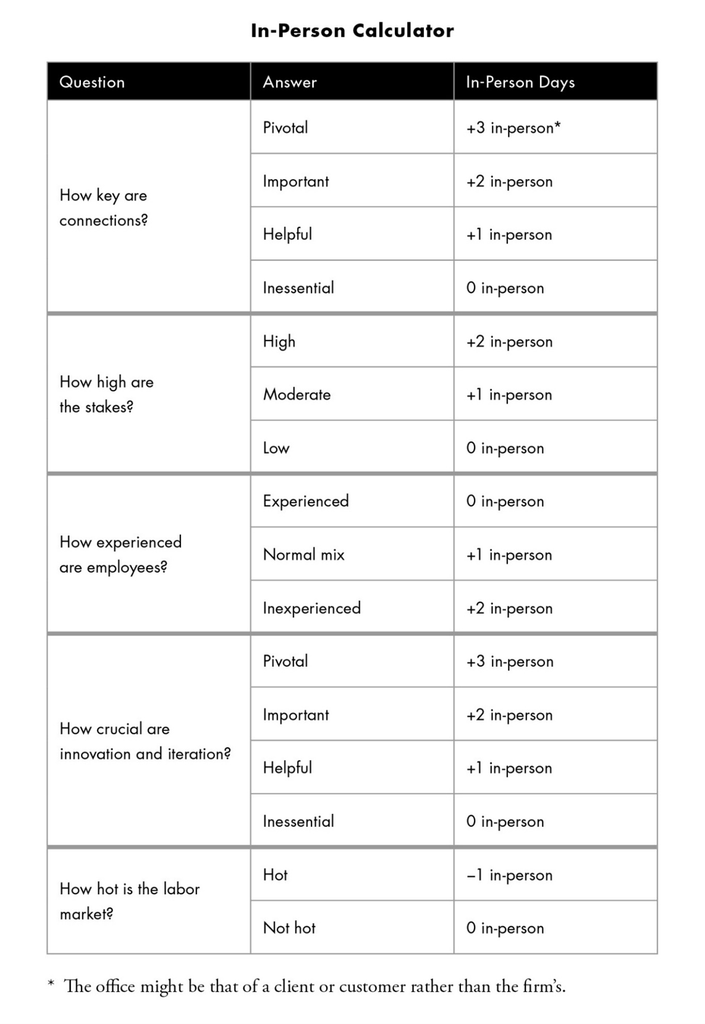
If the score is 5 or higher, a full return to the office is likely called for. If the score is 0 or lower, it likely makes sense to be fully remote.
Some organizations may choose to cluster in-person work by the month or around key moments. Others may find it more helpful to take a few hours of remote work every day to facilitate school pickups. The crucial element is that when the team opts to gather, it is a coordinated effort that allows people to connect face-to-face with their colleagues.
Excerpted from IN PERSON by Natalia Emanuel, PhD and Emma Harrington, PhD. Copyright © 2026 by Natalia Emanuel and Emma Harrington. Published in the United States by Crown Currency, an imprint of the Crown Publishing Group, a division of Penguin Random House LLC.